Alexandria Ocasio-Cortez's Record on AI
Formal support for a conditional pause on advanced AI and a superintelligence ban
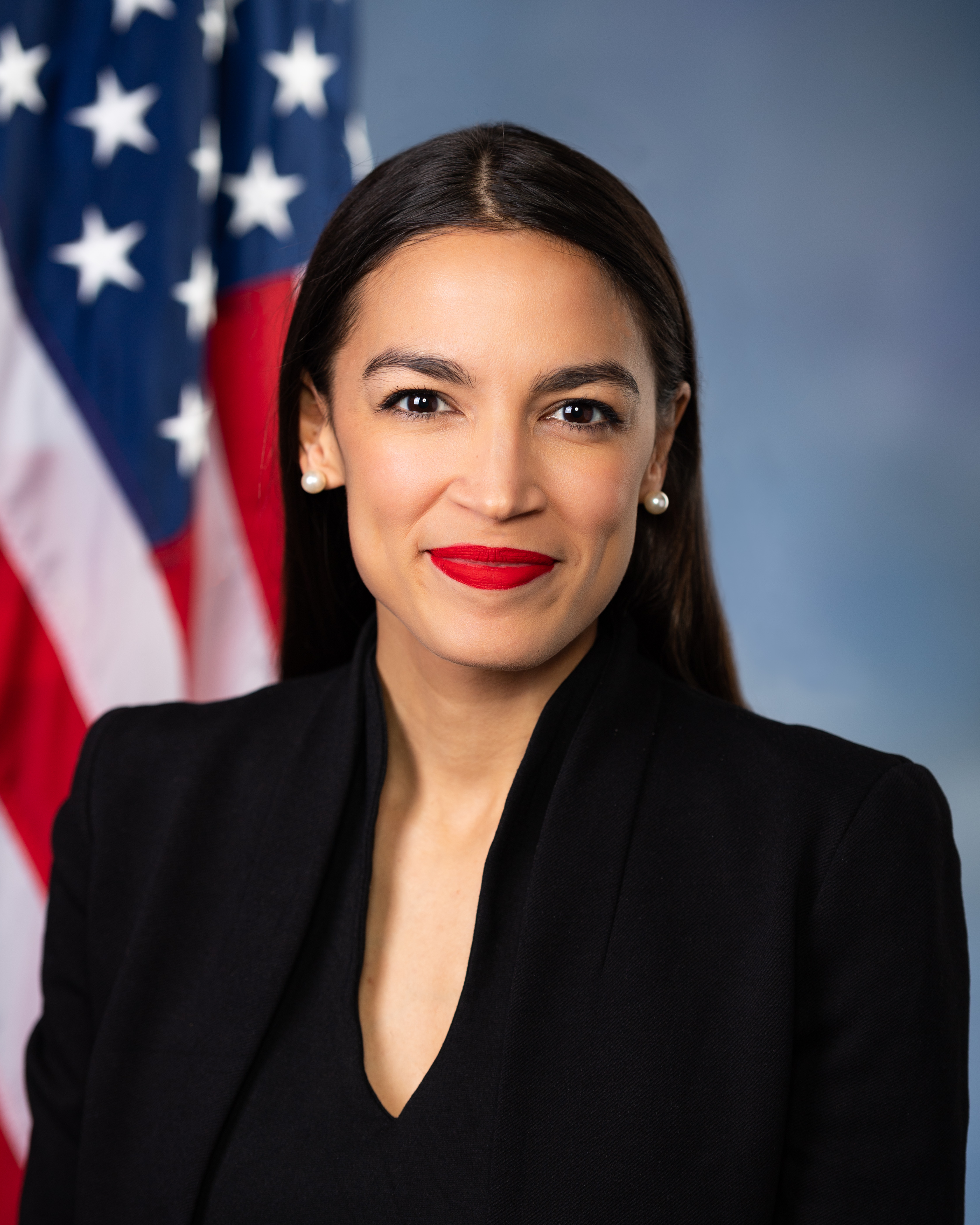

Her record on artificial intelligence (AI) includes formal support for a conditional pause on advanced AI and a ban on superintelligence, shown through bills she sponsored or cosponsored. Alexandria Ocasio-Cortez is the Democratic U.S. Representative for New York's 14th congressional district.
She cosponsored H.R. 10538, the Ban Artificial Superintelligence Act of 2026, and sponsored H.R. 9442, the Artificial Intelligence Data Center Moratorium Act. The official records checked for this page show no enactment of either bill.
- Party
- Democratic
- State
- New York
- Office
- U.S. Representative, New York's 14th congressional district
- Age
- 37 as of 2026-11-05 · Source
- Political Leaning
- Congressional Progressive Caucus member (roster checked November 5, 2026).
- Election Status
- A FOX 5 NY live-results report reports an Associated Press call reelecting her in New York's 14th district.
Alexandria Ocasio-Cortez's Position on AI
Alexandria Ocasio-Cortez formally supports a conditional pause on advanced AI and a ban on superintelligence. Her sponsorship and cosponsorship records establish that support for the specific restrictions in two introduced bills. They do not establish opposition to every form or use of AI.
The first bill is H.R. 10538, which she cosponsored on September 28, 2026. It would pause advanced-AI training, modification, fine-tuning and unreleased deployment until a Department of Artificial Intelligence is staffed and safety rules are issued. It would also prohibit developing, deploying, possessing, funding, importing or transferring superintelligence.
The second bill is H.R. 9442, which she sponsored on June 24, 2026. It would halt construction or upgrading of covered AI data centers once enacted, and that pause would end only after several conditions are met. The bill sets no fixed one-year expiration.
The record includes two recorded House votes: a Nay on the House suspension vote for the AI for Main Street Act on January 20, 2026, according to the House Clerk's roll-call record. She was recorded Yea on the House vote for the TAKE IT DOWN Act on April 28, 2025, according to the House Clerk's roll-call record. The two votes concern different bills, and the sources do not state her reasons for either.
Background at a Glance
The 2026 Congressional Directory lists her birth date as October 13, 1989. That date makes her 37 years old on November 4, 2026, and the Directory lists her party as Democratic.
The Directory lists her current office as U.S. Representative for New York's 14th district.
| Item | Detail |
|---|---|
| Date of birth | October 13, 1989 |
| Age | 37 as of November 4, 2026 |
| Party | Democratic |
| State and district | New York, 14th district |
| Current office | U.S. Representative |
| Bioguide ID | O000172 |
Alexandria Ocasio-Cortez's Background and Political Leaning
Her official congressional biography says she was born in Parkchester, in the Bronx, and that her family moved to Yorktown so she could attend school there. It describes her mother as a domestic worker from Puerto Rico and her father as a small-business owner. The Directory gives her birthplace as New York City.
The Directory lists a B.A. in international relations and economics from Boston University, completed in 2011. The biography says she worked as a waitress and bartender after her father died, and the Directory also lists bartender, waitress and front-of-house manager roles.
The Directory lists a career that began in community organizing. It includes work as an organizer for Bernie Sanders's presidential campaign, educational director at the National Hispanic Institute, founder of Brook Avenue Press, and a foreign affairs and immigration liaison in the office of Senator Ted Kennedy.
Alexandria Ocasio-Cortez's Statements and Actions on AI
On June 24, 2026, in her press release introducing the House version of the AI Data Center Moratorium Act, she said, "We must choose humanity over profit." She also said Congress should stop expansion until it has a framework addressing AI-related societal harms.
- December 17, 2025: in published remarks as delivered at an Energy and Commerce subcommittee hearing, she opposed a proposed ten-year ban on state AI regulation and Trump's effort to block state AI rules. These remarks are her published criticisms and do not provide a legal analysis of the executive order.
- April 16, 2026: a release from Representative Daniel Goldman's office names her as a signatory to a joint demand for answers on U.S. Immigration and Customs Enforcement (ICE) use of Palantir-developed technologies. The release shows participation in joint oversight. It does not establish a finding of unlawful surveillance.
- November 5, 2025: a release from Representative Jesus Garcia's office lists her as a cosigner of a letter to Delta's chief executive about AI use in ticket pricing. The letter requests answers and does not prove unlawful conduct, and it does not ban airline pricing algorithms.
Policies Supported, Opposed and Voted On
Her official AI record includes two bills she sponsored or cosponsored in 2026, one AI pricing bill from 2025 that she cosponsored, and two recorded House votes. The House votes are roll call 33 of 2026 and roll call 104 of 2025, and the table below lists each item in date order.
Only the TAKE IT DOWN Act is enacted in the official records checked for this page. The other measures are introduced bills or a House-passed bill with no enactment recorded, so their rows show proposals, referrals or House votes. Sponsorship and cosponsorship are not roll-call votes.
| Date | Measure | Her role or vote | Status and operative effect |
|---|---|---|---|
| April 28, 2025 | TAKE IT DOWN Act (S. 146) | Yea, House suspension vote, which passed 409 to 2 | Public Law 119-12 on May 19, 2025. Restricts knowing publication of nonconsensual intimate depictions, including specified digital forgeries created with AI or other software |
| January 7, 2026 (cosponsorship as of) | Stop AI Price Gouging and Wage Fixing Act of 2025 (H.R. 4640) | Cosponsor | Referred July 23, 2025 to Energy and Commerce, Judiciary, and Education and Workforce; no passage or enactment in the official record |
| January 20, 2026 | AI for Main Street Act (H.R. 5764) | Nay, House suspension vote as amended | Passed the House 395 to 14. Received in the Senate January 26, 2026 and referred to Small Business and Entrepreneurship; no law entry |
| June 24, 2026 | Artificial Intelligence Data Center Moratorium Act (H.R. 9442) | Sponsor | Introduced and referred to Energy and Commerce and Foreign Affairs; no enactment recorded |
| September 28, 2026 | Ban Artificial Superintelligence Act of 2026 (H.R. 10538) | Cosponsor, not an original cosponsor | Referred to the Committee on Oversight and Government Reform; no enactment recorded |
The Proposed Advanced AI Pause and Superintelligence Ban
H.R. 10538 starts its advanced-AI definition at training compute of 10^25 integer or floating-point operations, and it adjusts that threshold annually. Its superintelligence definition includes systems with broadly superhuman cognition or a capacity to destroy or disempower humanity.
The advanced-AI pause covers training, modification, fine-tuning and unreleased deployment. It would last until a cabinet-level Department of Artificial Intelligence is staffed and safety rules are issued, and limited remedial work is excepted.
The prohibition covers developing, deploying, possessing, funding, importing or transferring superintelligence and systems with enumerated precursor characteristics. Under the introduced text, advanced models would need predeployment approval.
Dangerous systems would be paused and isolated, and they could be rendered inoperative. Developers would report discoveries within 24 hours and file developer charters. Specified reckless violations could bring penalties of up to 20 years in prison.
The bill also protects whistleblowers, pursues international agreements against superintelligence and restricts federal funding for prohibited activities. Only the Department of Artificial Intelligence may use a narrow exception to fund defensive cybersecurity research with systems that have the unauthorized-access characteristics in Section 3(6)(B).
Section 13(c)(3) lets the Secretary waive the 10-year AI-industry employment bar for a non-policymaking individual who submitted information to the Secretary about a violation of Section 8, 9 or 12, when the waiver is consistent with the department's protective purpose. That waiver is discretionary, and it does not provide automatic immunity from every penalty.
The pause is conditional: it lasts until the department is staffed and safety rules are issued. This is the operative text of an introduced bill, and it is not law.
The Proposed AI Data Center Moratorium
H.R. 9442 would halt construction or upgrading of new or existing covered AI data centers upon enactment. Its covered definition includes facilities used for AI models at scale. An alternative branch covers facilities over 20 megawatts (MW) with high-density rack power of at least 20 kilowatts (kW) or liquid or immersion cooling.
The bill does not automatically cover every server facility. The pause would end only after laws establish product review, worker and benefit-sharing protections, utility and environmental protections, community approval, no subsidies and union labor standards, and the pause is expressly terminated.
The bill sets no fixed one-year expiration, so the pause ends when those conditions are met. It would require quarterly public Energy Department reports on financing, water, power, emissions, wastewater, cooling chemicals, noise, jobs, agreements and subsidies.
Verification powers include inspections and subpoenas. The bill also restricts computing-infrastructure exports, reexports and in-country transfers for covered AI uses to entities in countries without comparable safeguards.
As introduced and referred, H.R. 9442 has no enactment in the official record. It is a proposal she sponsored.
Current Office and the 2026 Election
The Directory lists her current office as U.S. Representative for New York's 14th district. A FOX 5 NY live-results blog reports an Associated Press call reelecting her in NY-14. Certification is not established by this media report.
That report carries a 9:14 p.m. local timestamp on November 3, 2026. The timestamp is the local time of the live update, not a separately verified time of the AP call.
The reported result does not change the current office listed in the Directory.
What the Record Establishes
The supported restrictions are specific. H.R. 10538 would pause advanced-AI training, modification, fine-tuning and unreleased deployment under stated conditions and would prohibit superintelligence. H.R. 9442 would halt covered AI data-center construction and upgrades until its listed laws are enacted.
The only enacted law in this record is the TAKE IT DOWN Act. The TAKE IT DOWN Act restricts knowing publication of nonconsensual intimate depictions, including specified AI-made digital forgeries. It is not a ban on all AI or all synthetic media.
The Nay vote on the AI for Main Street Act does not establish her reason. The House-passed text would require small business development centers to help businesses evaluate and use AI, and Section 3 authorizes no additional funding.
The records checked for this page do not establish opposition to every form or use of AI.
Reading Alexandria Ocasio-Cortez's AI Record
H.R. 10538 and H.R. 9442 mainly set conditions on developing advanced AI systems and building covered AI data-center infrastructure, while the TAKE IT DOWN Act is a use-focused safeguard that restricts knowing publication of specified nonconsensual intimate depictions. Readers can check the operative text of H.R. 10538 on Congress.gov and H.R. 9442 on Congress.gov. Introduced text does not show current law.
Frequently Asked Questions
Does Alexandria Ocasio-Cortez oppose all AI?
The official records show formal support for a conditional pause on advanced AI, a superintelligence ban and a data center moratorium bill. They do not show opposition to every form or use of AI.
Her record also includes a Nay vote on the AI for Main Street Act. The sources do not state her reason for that vote.
Is the superintelligence ban in effect?
No. She cosponsored H.R. 10538, and the record shows the bill referred to the Committee on Oversight and Government Reform. The official records show no enactment, so the ban and the advanced-AI pause remain proposals.
Did she vote for the TAKE IT DOWN Act?
Yes. The House Clerk's roll-call record shows her recorded Yea on the House suspension vote on April 28, 2025. The House passed the bill 409 to 2, and it became Public Law 119-12 on May 19, 2025.
Was she reelected in 2026?
A FOX 5 NY live-results report reports an Associated Press call reelecting her in New York's 14th district. Certification is not established by this media report.
Why did she vote against the AI for Main Street Act?
The sources do not state her reason. The Clerk record shows a Nay on the House suspension vote, and the House-passed text would have small business development centers help businesses evaluate and use AI. Section 3 of that text authorizes no additional funding.