Gavin Newsom's Background and AI Policy Record
California governor's AI record, from the 2024 SB1047 veto to 2026 orders and bills
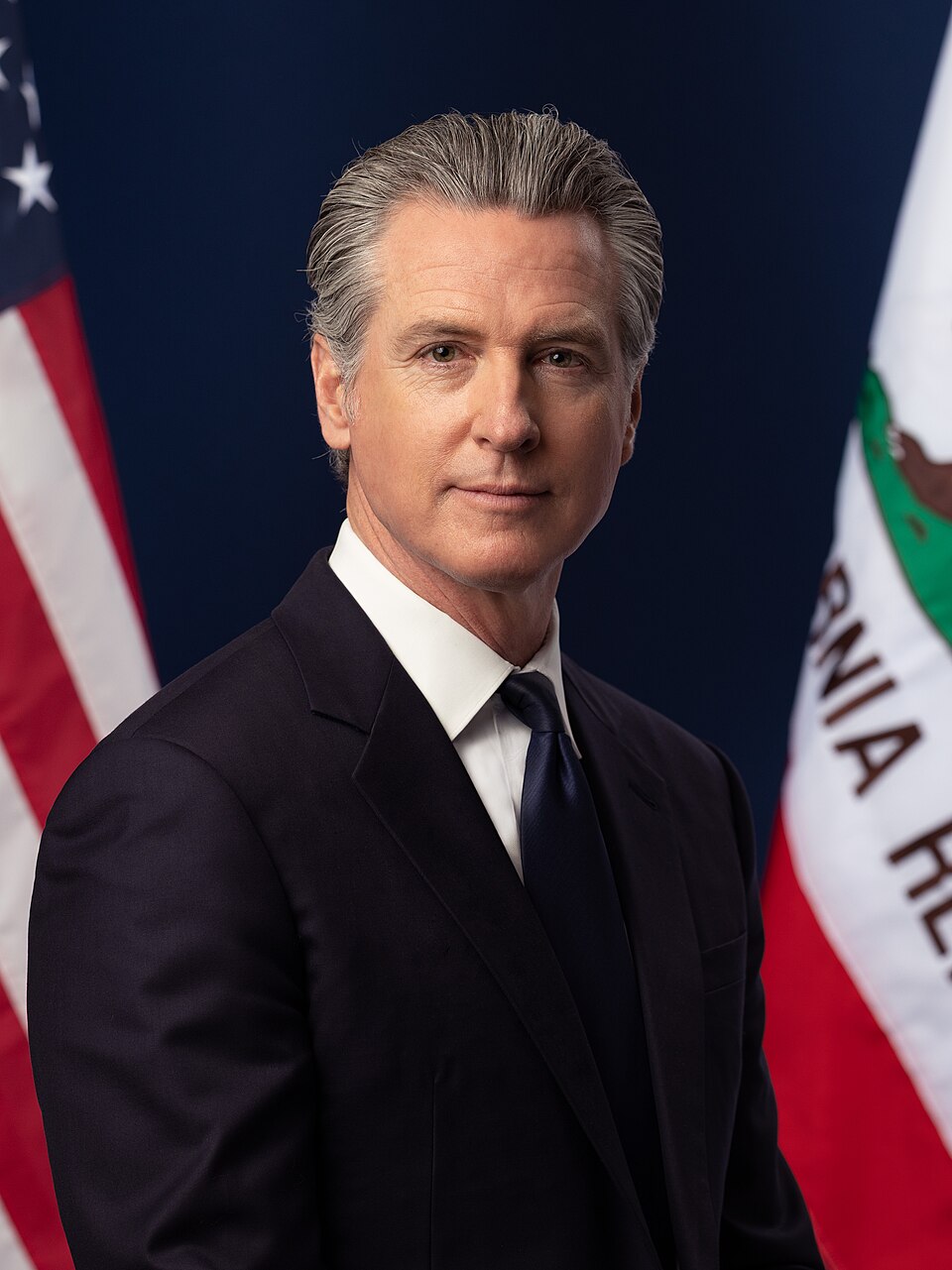

Gavin Newsom vetoed SB1047 in 2024 and has since signed AI bills on worker and child protections, according to the governor's own announcements. His September 2026 executive order asks for kill-switch recommendations, and it does not impose an immediate universal shutdown mandate.
- Party
- Democratic
- State
- California
- Office
- Governor of California (second term began 2023)
- Age
- 59 as of 2026-11-05 · Source
- Political Leaning
- Not established beyond party affiliation.
- Election Status
- Current governor, with a second term that began in 2023; not a candidate in the 2026 gubernatorial election, and no 2026 reelection call is established here.
Gavin Newsom's Position on AI
Newsom vetoed SB1047 in 2024 and has since signed targeted AI measures covering workers and children. His September 2026 order asks for kill-switch recommendations rather than imposing an immediate universal shutdown mandate.
Background at a Glance
The National Governors Association (NGA) profile for California lists the identity details in this table.
| Field | Detail |
|---|---|
| Name | Gavin Newsom |
| State | California |
| Party | Democratic |
| Office | Governor since 2019 |
| Current term | Second term, which began in 2023 |
| Date of birth | October 10, 1967 |
| Age | 59 as of November 4, 2026 |
Gavin Newsom's Background and Political Leaning
The official governor biography says Newsom was born in San Francisco and attended Redwood High and Santa Clara.
Before he was elected mayor of San Francisco in 2003, he served on the city's parking and traffic commission and its Board of Supervisors. The biography says he later served as lieutenant governor and then as governor.
The biography also describes his PlumpJack wine-shop business, which later expanded into restaurants, hotels and wineries. It identifies his wife, Jennifer, a filmmaker, and their four children.
His Democratic affiliation is established. No finer ideological label is established, so this page does not assign one.
Gavin Newsom's Statements on AI
In a September 29, 2024 announcement, Newsom explained his veto of SB1047. He said the bill did not account for high-risk deployment environments, critical decision-making or sensitive data, while imposing stringent standards on basic functions if a large system deploys them. The announcement says he paired the veto with alternative safety work.
It identifies Fei-Fei Li, Tino Cuellar and Jennifer Tour Chayes as helping with empirical, science-based analysis of frontier capability and risk. It also reports that he signed SB 896 and directed Cal OES to expand catastrophic-risk assessment of critical infrastructure, including water and communications after energy. This describes the announcement's scope, not an independent assessment of results.
That veto is not evidence that Newsom rejects all AI regulation. The same announcement pairs the veto with the alternative safety work, so the two should be read together.
The N-6-26 workforce order, signed May 21, 2026, sets a 90-day research review of AI's workforce impacts, including demographic disparities and early warnings. It also calls for recommendations within 180 days on updates to WARN rules.
The order sets these reviews on 90-day and 180-day periods.
The order also directs a 180-day review of the safety net and of possible severance, equity and compensation approaches. Those are studies and recommendations, not enacted universal severance or equity rights, and this page does not establish any completed outcome.
Newsom's two-page signed message, dated September 29, 2025, says he signed the bill for state oversight of how artificial intelligence (AI) is used, assessed and governed, and for responding to critical incidents. He ties the bill to an expert report he commissioned after his 2024 veto. He presents innovation and public safety as joint goals and calls California a blueprint while federal policy is absent.
The message sets out a conditional federal position. If the federal government or Congress adopts national AI standards that maintain or exceed SB 53's protections, the message says subsequent action would be needed to align the rules and avoid duplicative or conflicting requirements. He says SB 53 creates a compliance pathway for critical incident reporting and urges the Legislature to monitor federal standards while maintaining the law's protections.
This is his stated policy, and the message does not describe automatic blanket preemption.
Policies Supported and Opposed
Executive order N-9-26, signed September 18, 2026, contains the oversight provisions, and its directives carry different deadlines.
Directives 1 and 2 carry deadlines in 2027. Directive 3 carries a November 16, 2026 deadline for recommendations only, which is the earliest deadline in the order.
The September 30, 2026 worker release lists SB 947, which covers automated employment decisions; SB 951, which covers technology displacement notices; and AB 1331 and AB 1883, which cover surveillance protections. The announcement describes human review in discipline and termination decisions, notice when mass layoffs, relocations or terminations are caused by AI, and limits on bathroom surveillance and workforce privacy. The same release also announces AI procurement and training in public higher education, says lawyers retain core legal judgment and health professionals retain clinical judgment, and describes developers addressing known or predictable clinical decision-tool bias and provenance and watermark transparency.
The release does not establish a blanket ban on AI in hiring.
The child-safety release describes SB1119 as covering companion-chatbot crisis protocols, parental controls, notices, audits and risk assessments for children. It also describes other social-media laws that are separate from SB1119, so those provisions should not be credited to that bill on the release alone.
Governor Gavin Newsom signed Senate Bill 53, the Transparency in Frontier Artificial Intelligence Act, on September 29, 2025. Senator Scott Wiener authored the bill, and Newsom acted as governor by signing it into law. The governor's announcement lists several parts of the law.
The announcement says large frontier developers would publish a public safety framework describing how national standards, international standards and industry-consensus best practices are incorporated. Companies and the public would have a mechanism to report potential critical incidents to the Office of Emergency Services (OES). The announcement alone does not settle mandatory reporting duties or deadlines.
The law also includes whistleblower protections and civil penalties enforced by the Attorney General. The Department of Technology would make annual recommendations for law updates based on multistakeholder input, technological developments and international standards. Separately, the CalCompute consortium within the Government Operations Agency would develop a framework for a public computing cluster for safe, ethical, equitable and sustainable AI research and innovation.
The announcement describes the cluster as something the consortium would design, not a computing cluster that already exists.
The Secretary of State's index lists SB 0053 as chapter 138 of the 2025 Statutes, approved September 29, 2025.
| Date | Action | Source |
|---|---|---|
| September 10, 2026 | Signing announced for SB1119, covering companion-chatbot protections for children | Child-safety release |
| September 18, 2026 | Executive order N-9-26 signed; the signed order controls over a press headline that suggested immediate kill-switch implementation | Signed N-9-26 order |
| September 30, 2026 | Signing announced for SB947, SB951, AB1331 and AB1883 | Worker release |
| November 16, 2026 | Recommendations due on on-site verification, safety documentation checks, verified kill-switch capability and loss-of-control incidents (directive 3) | Signed N-9-26 order |
| May 1, 2027 | Directive 1 deadline for verification-organization criteria | Signed N-9-26 order |
| December 1, 2027 | Directive 2 deadline for auditor-registry actions | Signed N-9-26 order |
Current Office and the 2026 Election
Newsom is California's current governor. He was not a 2026 governor candidate, and the record shows no reelection call.
What the Record Establishes
The governor's office announced AskCA on September 9, 2026, as a prototype AI-powered tool to help people navigate government information and services. That announcement is the governor's own description, so it is not independent evidence of performance or of a completed statewide rollout.
Readers with a specific question can start with these sources:
- Workplace rules: the worker release names four bills, and its description is the only scope this page uses for them.
- State AI tools: read AskCA as the governor's description of a prototype, not as a measured result.
- Kill-switch requirements: read directive 3 in the signed N-9-26 order before relying on any kill-switch claim, because its November 16, 2026 deadline covers recommendations.