Liz Krueger's Record on Artificial Intelligence
New York State senator and cosponsor of a proposed one-year pause on large data center permits
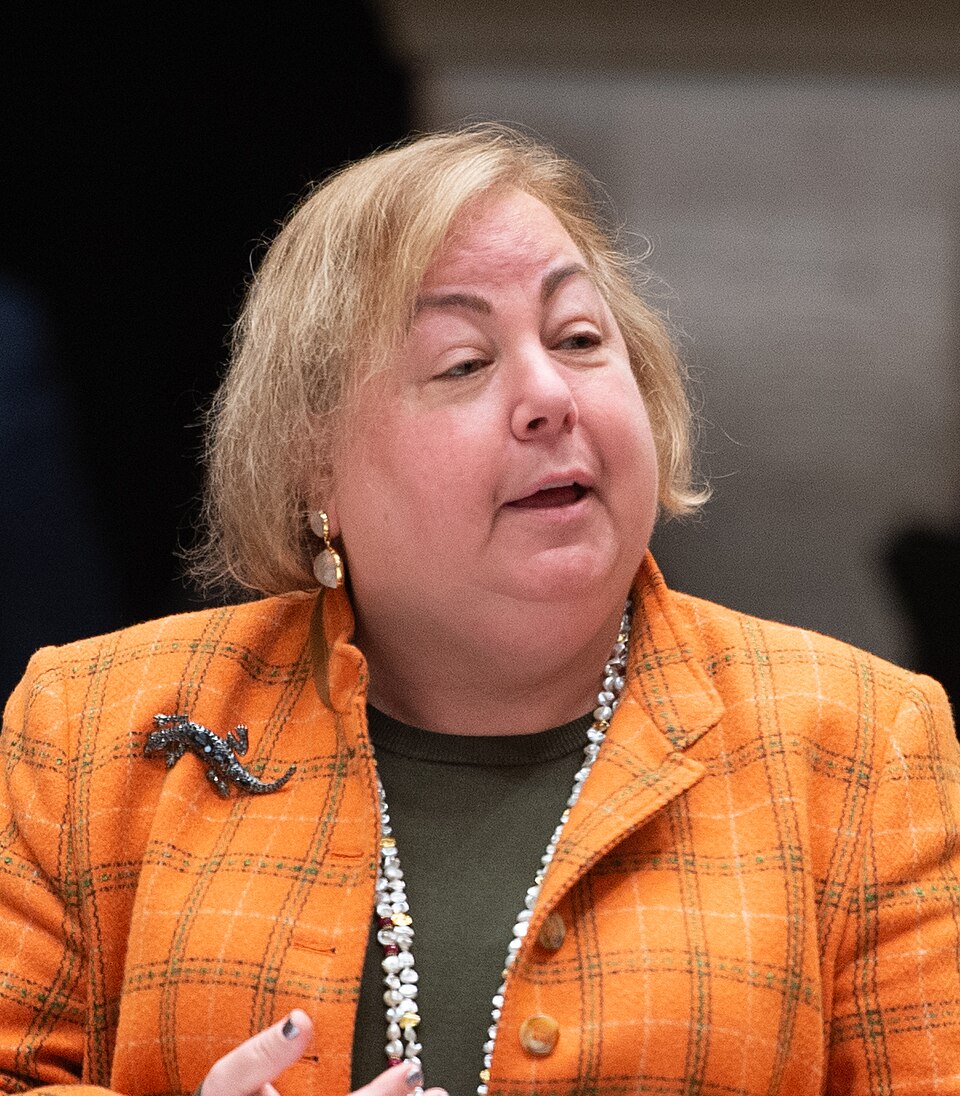

Liz Krueger is a New York State senator for District 28 whose record on artificial intelligence (AI) centers on S10642, a bill that would pause new large data center permits for one year. The Senate passed the bill through a substitute Assembly bill, A11560, on June 4, 2026, and Krueger is listed as an aye vote.
The bill also sets longer-term conditions for utility rates, renewable electricity and host communities. Krueger's June 2026 constituent newsletter says she and Senator Gonzalez jointly urged Governor Hochul to sign it.
- Party
- Democratic / Working Families
- State
- New York
- Office
- New York State Senator, District 28
- Age
- No verified birth date or dated age found.
- Political Leaning
- Not established beyond party affiliation.
- Election Status
- No result from the November 3, 2026 election is reported in the sources used here, so this page does not treat her as newly elected or as winning a new term.
Liz Krueger's Position on AI
Liz Krueger's documented position on AI is support for S10642, a temporary pause on new large data center permits paired with longer-term conditions for utility customers and host communities. She is listed as a cosponsor and an aye vote, and the record does not show a position on AI uses outside data centers.
Her June newsletter frames the pause as time for utility protections, clean generation, host benefits and pollution safeguards, while preserving potential economic growth. The same newsletter says the final one-year proposal incorporates elements of her S9144 moratorium legislation.
The bill text names Senator Gonzalez as introducer, and the public sources used here do not separately establish what S9144 contained. The newsletter is therefore her own account of that overlap.
Her official Senate profile lists sponsorship of the SUNNY Act, which promotes plug-in solar.
Liz Krueger's Background
Her profile lists a bachelor's in Social Policy and Human Development from Northwestern University and a master's in public policy from the University of Chicago Harris.
She was founding director of the New York City Food Bank, then spent 15 years as associate director of the Community Food Resource Center, focused on public-program access for low-income New Yorkers.
Committees include Finance chair, Budget and Revenue, Cannabis and Rules.
- Previously chaired the NYC Food Stamp Task Force and co-facilitated the NYC Welfare Reform Network.
- Founding co-chair, bipartisan Pro-Choice Legislative Caucus, on reproductive-health and equal-rights measures.
- Profile credits: Climate Change Superfund Act, gas-subsidy repeal, fracking opposition, plastic-bag ban, pension divestment.
Liz Krueger's AI Policy Record
S10642, the Responsible Data Center Development Act, would amend the Environmental Conservation Law, the Public Service Law, the Public Authorities Law, the Energy Law and the Labor Law. Senator Gonzalez introduced it on June 1, 2026. The provisions described below are from that introduced text; the June 4 Senate roll call was on Assembly substitute A11560, and the substitute's wording is not confirmed identical.
The June 4 Senate roll call recorded 43 ayes and 17 nays, with one senator absent and two excused. Senators Gonzalez, Krueger, Brisport and Jackson are individually listed as aye votes, and Krueger and Jackson are also listed as cosponsors.
Under the bill, a data center is one facility or a combination of facilities under common ownership or control at the same site that receives electric, gas or water service from a utility or municipality, has applied or requested such service, or has caused a utility or municipality to incur an expense in providing service under the Public Service Law. The facilities must also have a peak demand of one megawatt (MW) or more used for computing infrastructure, data processing, web hosting, streaming support or related services.
Manufacturing, software publishing and streaming distribution are excluded from those uses. Facilities majority-owned, operated or controlled by a public research institution and used for research are not data centers under the bill.
A large data center has a peak demand of 20 MW or more, so a facility at exactly 20 MW qualifies. The provisions below use that threshold, along with lower thresholds of 5 MW for several renewable and labor standards.
- Permit pause (Environmental Conservation Law Section 31-0103): the Department of Environmental Conservation (DEC) may not issue any permit, certificate, registration, license or other approval to a large data center until one year after the act takes effect. Renewals, modifications, reissuances and recertifications of earlier approvals are excluded, and so are large data centers that began construction on or before the effective date.
- Host community hearing (Section 31-0105): before DEC can issue an approval, the data center, in coordination with the Public Service Commission (PSC), must hold at least one in-person public hearing in at least one host community. The hearing must take place at least three months before issuance, and the data center must address its efforts to reduce negative impacts.
- Hearing notice and costs (Section 31-0105): the operator must give residents of host communities at least 30 days of advance notice, including projected energy use, water and wastewater impacts, and the state and local incentives applied for or already awarded. The data center also pays all hearing expenses, including the costs of DEC and the Department of Public Service.
- Environmental impact report (Section 31-0107): DEC, consulting other agencies, must prepare a report on data center development covering electricity and water use, land and farmland, air, water and noise pollution, electronic waste, and public funds such as tax incentives. The report must also assess effects on disadvantaged communities and Indigenous nations within a ten-mile radius, and it must recommend legislation that minimizes pollution and water use.
- Report process and deadline (Section 31-0107): a draft report must be posted for at least 120 days of public comment, with in-person hearings in at least five of the nine regions the bill names. DEC must issue the final report no later than 18 months after the article becomes law.
- Utility rate classes (Public Service Law Section 65(5) for gas and electric service, and Section 89-b(5) for water): each utility or municipality must file a separate service classification for large data centers and update existing classifications to exclude them. That classification must assign the infrastructure, operating and rate-of-return costs caused by large data centers to those facilities, and must ensure no increases to surcharges, basic service or fixed charges not directly tied to actual use.
- Cost adjustment (same sections): an annual adjustment mechanism, run with the federally designated bulk system operator, must make sure commodity price increases after the effective date, including transmission service fees attributable to large data centers, are borne by those facilities.
- Approval condition (Public Service Law Section 114-b): the PSC may not approve a rate change or related tariff update after the effective date unless it includes a large data center classification and an adjustment mechanism. The PSC must ensure those classifications are fully implemented no later than June 1, 2030.
- Renewable electricity standards (Energy Law Section 19-103): data centers with a peak load of five MW or more must show through annual third-party verification that they procure, by contract or on-site generation, at least one-third of their electricity from renewable energy systems in 2030 through 2034. The required share rises to two-thirds for 2035 through 2039 and to 90 percent for 2040 and after.
- On-site renewable generation (Section 19-105): data centers with a peak load of five MW or more must also show each year, through third-party verification, that they derive as much energy as is technologically, environmentally and practically feasible from on-site renewable generation.
- Host community program (Section 8): each new large data center, and each existing one whose major expansion adds 20 MW or more, must fund a program. The program covers residential technologies such as heat pumps, distributed solar and behind-the-meter battery storage, plus community infrastructure such as local broadband, noise mitigation, municipal drinking water and pollution mitigation.
- Water measures (Section 8): the data center must fund all appropriate measures necessary to fully prevent increased water pollution, wastewater strain, water scarcity and other adverse impacts to waters, except adverse impacts already addressed under Public Service Law Section 89-b(5)(b). The text names closed-loop cooling systems, which recirculate water with minimal fresh intake, as one example.
- Program oversight (Section 8, subdivisions 3 and 4): the PSC must start a proceeding within 90 days to set the program and must prioritize low- and moderate-income households and disadvantaged communities. Each large data center must submit independently audited financial reports on the fund each year.
- Prevailing wage (Section 8, subdivision 5): community infrastructure projects costing at least $1 million must pay prevailing wages. Exceptions cover projects under certain pre-hire collective bargaining agreements, construction on one- or two-family homes that are the owner's primary residence, property whose owner holds no more than four dwelling units, and some privately owned multifamily projects with qualifying affordable or supportive housing.
- Labor standards for covered data centers (Labor Law Section 224-g): a covered data center has a peak demand of five MW or more, and its construction is subject to prevailing wage requirements, with an exception for pre-hire collective bargaining agreements. The owner or developer must require apprenticeship agreements or workforce training, and must require that iron and steel used in construction be produced or made in whole or substantial part in the United States.
- Long Island Power Authority (Section 9): the Long Island Power Authority must set up a program for large data centers in its territory with the same objectives as the host community program.
- Efficiency goals (Public Authorities Law Section 1854-e): within one year, the authority, with the federally designated bulk system operator, the PSC and the New York State Climate Action Council, must set energy efficiency goals for data center design and operation. Operators that began before the effective date have two years to comply, and those starting within the first year have one year.
- Severability and effective date (Sections 11 and 12): if a court invalidates one part, the rest stays in force after judicial review ends. The act takes effect immediately.
| Instrument | Krueger's role | Dated action | Policy effect and status |
|---|---|---|---|
| S10642, Responsible Data Center Development Act | Cosponsor and aye vote | Introduced June 1, 2026; Senate roll call June 4, 2026 | Creates a one-year pause on new large data center approvals, plus hearing, rate, renewable and host community conditions. Senate roll call was on substitute A11560; detail reflects S10642 as introduced; no enacted law shown. |
| S9144, moratorium proposal | Her proposal, per her June newsletter | June 2026; bill date not stated | Newsletter says elements were incorporated into S10642. Enactment not shown. |
| Request that Governor Hochul sign S10642 | Joint request with Senator Gonzalez, per her June newsletter | June 2026 | No gubernatorial action shown. |
Limits of Liz Krueger's AI Opposition
S10642 is a conditional pause on one class of facilities, not a ban on data centers or AI. The one-year pause covers only approvals issued by DEC for large data centers, and it excludes renewals, modifications and large data centers that began construction on or before the effective date.
Data centers from 1 MW to below 20 MW fall under the definition but outside the pause. The renewable electricity standards begin at 5 MW, and the labor standards cover covered data centers at 5 MW or more.
After the pause year, the host community hearing still applies to any large data center approval under the bill. The environmental impact report must review public funds and tax incentives that data centers receive, but the text sets no cap on those incentives and does not require a study of economic benefits.
The newsletter says the pause preserves potential economic growth. The hearing notice requires disclosure of incentives, covering those applied for and already awarded.
The sources used here contain no personal statement from Krueger on AI uses outside data centers. Her view on those uses is unknown, not favorable or unfavorable.
Liz Krueger's Office and Election Status
Liz Krueger is a state senator for District 28, with Democratic and Working Families affiliations. She was first elected to the Senate in 2002.
No result from the November 3, 2026 election is reported in the sources used here. This page therefore does not describe her as newly elected or as winning a new term.
Her full birth date and current age are not established in the public sources used here. This page states no age for her.
Reading Liz Krueger's AI Record
Liz Krueger's documented AI record is a cosponsorship and aye vote on S10642, plus her own statements about the bill and its overlap with her S9144 proposal.
On the sources reviewed, she supports a temporary pause on new large data center permits and longer-term protections for utility customers and host communities. The record does not establish a position on AI outside that bill's scope.
The conclusion would change if the bill is enacted, amended or replaced, or if Krueger casts a new recorded vote or makes a public statement that changes what the bill covers.
To track the bill's status, check the S10642 bill page on the New York Senate website.
Frequently Asked Questions
Did Liz Krueger vote for S10642?
The June 4, 2026 Senate roll call lists her as an aye vote, and the bill text also lists her as a cosponsor. Cosponsoring and voting aye are separate actions, and the bill text names Senator Gonzalez as introducer.
Is the large data center pause law?
The sources used here do not show it as law. The Senate passed the bill through the substitute Assembly bill A11560, but those sources do not show the rest of the constitutional enactment process as complete.
Does S10642 ban large data centers?
No. For one year after the act takes effect, the Department of Environmental Conservation cannot issue new large data center approvals, and renewals, modifications and earlier construction are excluded.
After that year, large data centers still face the host community hearing requirement, the utility rate class requirements and the renewable electricity standards that apply at 5 MW and above.
Did Liz Krueger write S10642?
The bill text names Senator Gonzalez as its introducer and lists Krueger as a cosponsor. Krueger's June newsletter says elements of her S9144 proposal were incorporated into the final one-year proposal, a claim the sources used here do not independently verify.