Maxwell Frost's Record on AI
Formal support for a proposed AI data center moratorium, alongside two House votes on AI bills
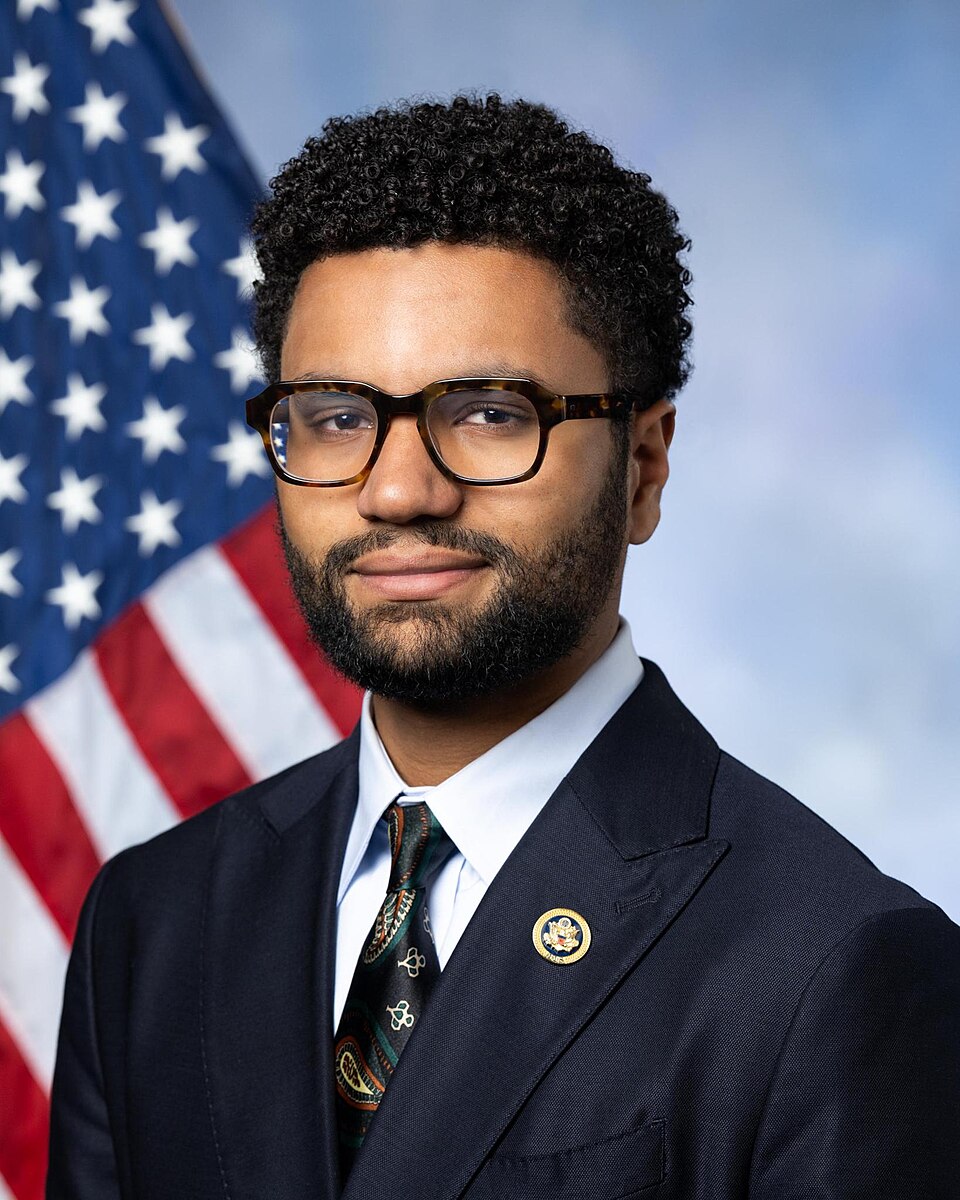

Maxwell Frost's record on artificial intelligence (AI) is mostly formal. It consists of three bill cosponsorships, two House roll-call votes and one joint oversight letter.
- Party
- Democratic
- State
- Florida
- Office
- U.S. Representative, Florida District 10 (current)
- Age
- 29 as of 2026-11-05 · Source
- Political Leaning
- Congressional Progressive Caucus member (roster checked November 5, 2026).
- Election Status
- Secured reelection unopposed at the June 12, 2026 qualifying deadline, with no contested November race, according to Florida Politics; certification is not confirmed in this record.
Maxwell Frost's Position on AI
Maxwell Frost formally supports a proposed moratorium on construction and upgrades of covered AI data centers, one that ends only after listed conditions are met. He is a cosponsor of H.R. 9442, the Artificial Intelligence Data Center Moratorium Act, which was introduced in the 119th Congress and has not been enacted.
His House votes on AI measures are recorded as follows. Frost voted yea on the AI for Main Street Act, which concerns business assistance, and on the TAKE IT DOWN Act, which covers nonconsensual intimate depictions, including some AI-made forgeries. Neither a cosponsorship nor a yea vote establishes a view on every AI use, and the sources do not establish blanket opposition to AI.
- Cosponsor of H.R. 9442, which would halt construction or upgrading of covered AI data centers until listed conditions are met.
- Cosponsor of H.R. 9939, which would bar covered AI data centers on federal land.
- Yea on H.R. 5764, the AI for Main Street Act, a House vote on January 20, 2026 to pass the bill as amended.
- Yea on S. 146, the TAKE IT DOWN Act, a House vote on April 28, 2025 that cleared a measure on nonconsensual intimate depictions.
Background at a Glance
The Congressional Directory and Frost's official biography supply the basic facts below. Age is calculated from the January 17, 1997 birth date as of November 4, 2026.
| Item | Detail | Source |
|---|---|---|
| Party | Democratic | Congressional Directory |
| Current office | U.S. Representative, Florida District 10 | Congressional Directory |
| Born | January 17, 1997, Orlando, Florida | Congressional Directory |
| Age | 29 as of November 4, 2026 | Calculated from the birth date in the Congressional Directory |
| 2026 race | Reelection to the current House seat, unopposed at the June 12, 2026 qualifying deadline | Florida Politics |
Background and Political Leaning
Frost was adopted at birth by a musician and producer father and a special-education teacher mother, according to his official biography. He was a percussionist at the Osceola County School for the Arts, and the Congressional Directory lists him as a graduate of that school in Kissimmee, Florida.
The directory also lists Valencia College in Orlando as an institution he attended. His organizing career began in 2016, with a field organizer role for Hillary for America and a deputy Florida director role at MoveOn. In 2018 he was a field manager for the American Civil Liberties Union (ACLU) of Florida, and from 2019 to 2021 he was national organizing director for March for Our Lives.
In 2017 and 2018 he also held roles with Brian Cunningham for City Council, Margaret Good for Florida House and Floridians for a Fair Shake. From 2017 to 2019 he worked in production dispatch for Coachella Music Festival LLC, and he was national advance manager for Bernie 2020 from 2019 to 2020. The directory also lists him as a driver for Uber Technologies in 2021 and 2022.
The official biography describes him as an ACLU organizer and March for Our Lives national organizing director before entering Congress. It also describes him as the first Generation Z member of the House, and those descriptions come from the office itself.
The sources establish his Democratic Party affiliation and no finer ideological label. This profile does not infer a leaning from party affiliation or from his organizing career, and it does not assign motives to his AI positions.
Statements and Actions on AI
On August 4, 2026, he led Florida House Democrats in a letter to Governor DeSantis and a state deputy secretary about the proposed use of AI to reduce SNAP error rates.
The letter asks about vendor qualifications, accuracy, bias safeguards, human oversight, transparency, appeals and contingency plans for an accelerated procurement. It challenges a specific benefits-administration deployment. It does not establish that AI had already denied any recipient benefits, and it does not establish a blanket objection to AI.
Because the letter is joint, its wording belongs to the signing Democrats as a group, not to Frost alone. The sources reviewed contain no individually spoken quotation from Frost on AI, so this section reports documented actions and does not attribute a view to him.
Policies Supported and the Vote Record
Frost cosponsored three bills and voted yea on two AI-related House measures, and only the TAKE IT DOWN Act is recorded as enacted. The two bills that restrict data centers differ in scope, so the table below gives each action its date and recorded status.
H.R. 9442 would halt construction or upgrading of new or existing covered AI data centers upon enactment. Its covered definition reaches facilities used for AI models at scale, along with facilities over 20 megawatts (MW) that have high-density rack power of at least 20 kilowatts (kW) or liquid or immersion cooling. The bill does not automatically cover every server facility.
The pause in H.R. 9442 ends only after laws establish product review, worker and benefit-sharing protections, utility and environmental protections, community approval, no subsidies and union labor standards. The pause must also be expressly terminated. The introduced text sets no fixed one-year expiry, so the pause depends on those conditions instead of a calendar date.
The same bill requires quarterly public Energy Department reports on financing, water, power, emissions, wastewater, cooling chemicals, noise, jobs, agreements and subsidies. Inspections and subpoenas are its verification powers. It also restricts computing-infrastructure exports, reexports and in-country transfers for covered AI uses to entities in countries without comparable safeguards.
H.R. 9939 uses a definition with two branches, an at-scale AI branch and a branch for facilities over 20 MW with high-density racks or liquid cooling. It would prohibit construction and operation of covered AI data centers and associated infrastructure on federal land. Agencies or lessees would have to stop and begin removal within 30 days after enactment, and remediation would be required. Federal land includes Defense land and excludes land held in trust for a tribe or tribal member.
H.R. 5764 would require small business development centers to help businesses evaluate and use AI. That help would take the form of information, guidance, training and outreach covering best practices, business operations, data and intellectual property, cybersecurity, regulatory compliance and trust. Section 3 authorizes no additional funding.
S. 146 addresses knowingly publishing nonconsensual intimate depictions, including specified digital forgeries made with AI or other software, subject to the law's conditions and exceptions. Covered platforms must provide a notice and removal process within one year of enactment and remove covered depictions within 48 hours of a valid request. It became Public Law 119-12 on May 19, 2025, and it is a harmful-use restriction, not a ban on all AI or all synthetic media.
The status record reviewed for H.R. 4640 shows introduction, referral to three committees and a July 23, 2025 action. It does not describe the bill's operative text, so the sources do not characterize its provisions. The business-assistance bill, H.R. 5764, covers training and guidance on how businesses evaluate and use AI.
| Date | Measure | Frost's role or vote | Status in the record |
|---|---|---|---|
| April 28, 2025 | S. 146, TAKE IT DOWN Act | Yea on House motion to suspend the rules and pass, roll call 104 of 2025 | Passed House 409 to 2; became Public Law 119-12 on May 19, 2025 (enacted) |
| October 21, 2025 | H.R. 4640, Stop AI Price Gouging and Wage Fixing Act of 2025 | Cosponsor | Introduced and referred; latest recorded action July 23, 2025; no passage recorded (proposed) |
| January 20, 2026 | H.R. 5764, AI for Main Street Act | Yea on House motion to suspend the rules and pass as amended, roll call 33 of 2026 | Passed House 395 to 14; received in Senate January 26, 2026 and referred; no law entry (proposed) |
| September 10, 2026 | H.R. 9939, No AI Data Centers on Federal Lands Act | Cosponsor | Introduced and referred to Natural Resources; latest recorded action July 23, 2026; no passage recorded (proposed) |
| October 5, 2026 | H.R. 9442, Artificial Intelligence Data Center Moratorium Act | Cosponsor | Referred to Energy and Commerce and Foreign Affairs; latest recorded action June 24, 2026; no enactment recorded (proposed) |
Current Office and the 2026 Election
Frost is the U.S. Representative for Florida's District 10 in the Congressional Directory, which is dated February 20, 2026. The record lists District 10 as the current district and does not separately confirm the district for the next term.
Florida Politics reported on June 12, 2026 that Frost secured reelection unopposed at the qualifying deadline, so no contested November race appears in the record. The same report says a prospective write-in candidate failed to qualify.
The record does not include a November vote total, and it does not confirm certification of a result. The directory predates the election, so it cannot verify November results. The missing certification record is an evidence limit, not proof that Florida has not certified the result.
Scope and Open Questions
Frost has formally supported two restrictions on AI data centers, H.R. 9442 and H.R. 9939, and neither is recorded as passed or enacted. Their reach differs: H.R. 9442 would pause covered facilities under its listed conditions, while H.R. 9939 limits covered facilities to federal land.
The supportive votes are scoped to specific measures, not a general position on AI. A yea vote on H.R. 5764 supports that business-assistance bill as a whole, and a yea on S. 146 addresses one harmful use. The record does not show Frost's position on other AI uses.
Several questions remain open. The sources do not show the operative text of H.R. 4640, and they do not show any individual vote beyond the two House entries reviewed. The joint SNAP letter raises questions about one state deployment, and the sources do not show whether those questions led to any change.
The record covers a bounded set of cosponsorships, roll-call entries and one joint letter, and it does not cover every statement or vote. To see whether H.R. 9442 has moved since its June 24, 2026 latest action, read its GovInfo status record. A later action would appear in that record.
Frequently Asked Questions
Does Maxwell Frost oppose all AI?
The sources do not establish opposition to every AI use. Frost cosponsored bills that would pause or restrict covered AI data centers, and he voted yea on the AI for Main Street Act and the TAKE IT DOWN Act. The record does not show his position on other AI uses.
Has the AI data center moratorium become law?
No enactment is recorded for H.R. 9442. It is an introduced bill, and its latest recorded action is a June 24, 2026 referral to Energy and Commerce and Foreign Affairs. Under the text, the pause would take effect only upon enactment.
Does cosponsoring a bill count as a vote?
No. Cosponsorship is a formal sponsorship record, and it does not add a roll-call vote. Frost's individual House votes on AI measures in the record are the yea on H.R. 5764 on January 20, 2026 and the yea on S. 146 on April 28, 2025.