Ro Khanna's Artificial Intelligence (AI) Record in Congress
Original cosponsor of House bill H.R. 10538, which has not been enacted.
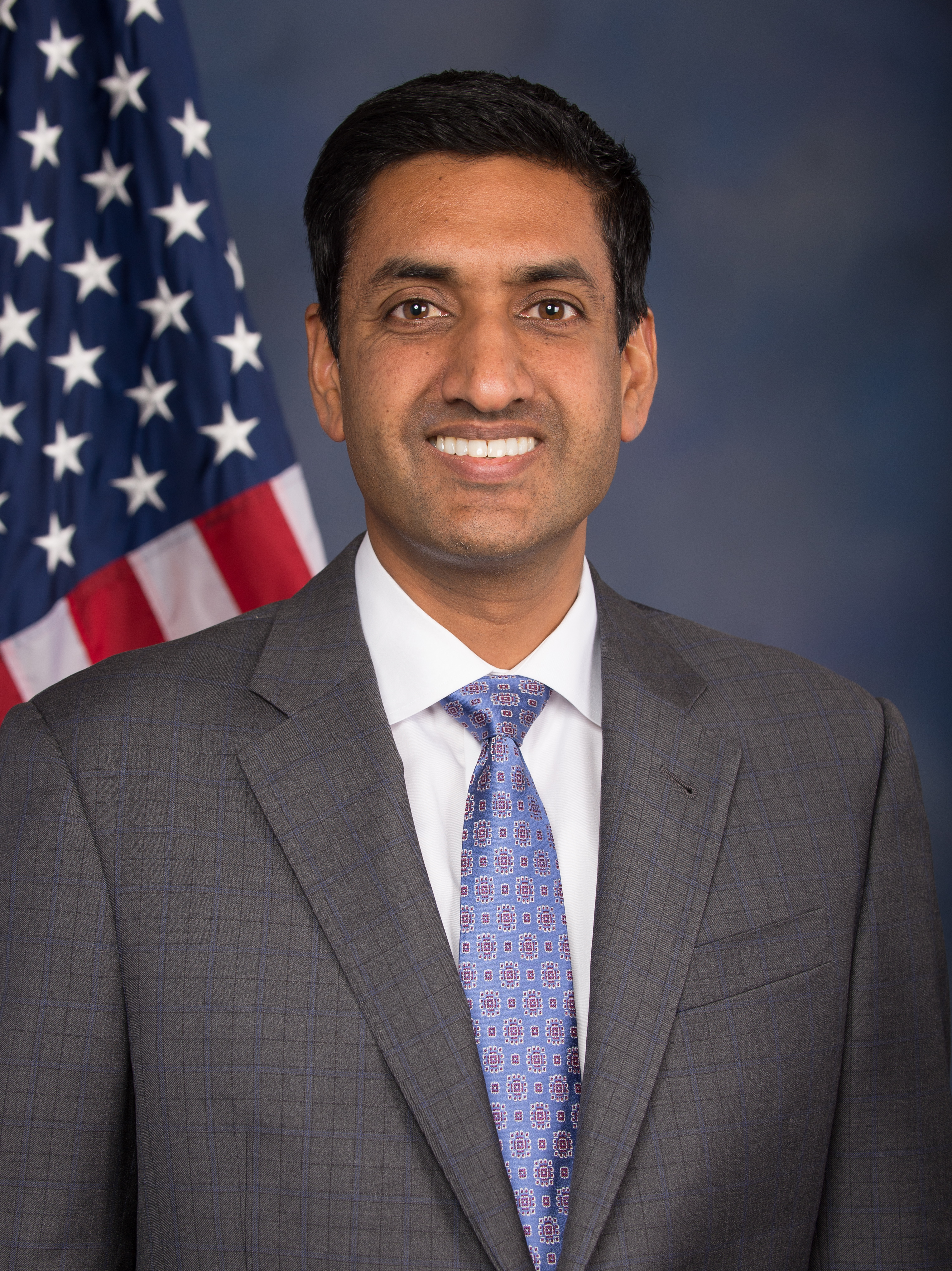

Ro Khanna is an original cosponsor of H.R. 10538, the Ban Artificial Superintelligence Act of 2026. That formal support covers a conditional pause on advanced AI and a superintelligence ban, and it does not establish opposition to every form or use of AI.
The bill has been referred to committee, and no enactment is recorded. The operative text would create a Department of Artificial Intelligence and set rules for advanced systems.
- Party
- Democratic
- State
- California
- Office
- U.S. Representative, California's 17th District
- Age
- 50 as of 2026-11-05 · Source
- Political Leaning
- Progressive, per his official congressional biography.
- Election Status
- Reelected in California's 17th District, per a call reported on the KQED results page; not certified in the inspected record.
Ro Khanna's Position on AI
Ro Khanna formally supports a conditional pause on advanced artificial intelligence and a ban on superintelligence. The support is recorded as sponsorship: the GovInfo bill status record lists him as an original cosponsor of H.R. 10538 on September 24, 2026.
This does not establish opposition to every form or use of AI. The bill's pause and ban turn on the definitions in its text, not on artificial intelligence as a whole.
The inspected record does not include an individually spoken quotation from Khanna about the bill.
Background at a Glance
The congressional directory lists Khanna's birth date as September 13, 1976, in Philadelphia, Pennsylvania. Calculated from that date, he was 50 years old on November 4, 2026.
His official congressional biography describes him as a Progressive and identifies membership or leadership in the Congressional Progressive Caucus. That affiliation does not establish agreement with every policy or a more specific ideology.
| Item | Detail |
|---|---|
| Party | Democratic |
| Current office | U.S. Representative, California's 17th District |
| Age on November 4, 2026 | 50 |
| Political label | Progressive, per his official biography |
Biography and Career Record
Khanna's official biography says his parents immigrated from India in the 1970s. It describes his father as a chemical engineer and his mother as a substitute schoolteacher.
The directory lists a bachelor of arts (B.A.) in economics from 1998 and a Juris Doctor (J.D.) law degree from 2001. It lists him as a lawyer from 2004 to 2009 and as deputy assistant secretary of commerce from 2009 to 2011.
From 2012 to 2016 the directory lists him as a visiting lecturer and law professor, and as a member of a California state workforce board. It also lists his 2012 book, Entrepreneurial Nation.
His official biography adds that he is a former Obama administration deputy assistant secretary of commerce, a former economics teacher, and the author of Dignity in a Digital Age. The directory presents the career history as a historical sequence and does not establish current committee roles.
AI Policy Record in Congress
Khanna's AI record in the inspected sources is one bill: H.R. 10538, the Ban Artificial Superintelligence Act of 2026.
The latest action in the inspected record is referral to the House Committee on Oversight and Government Reform on September 24, 2026. No enactment is recorded.
| Bill | Khanna's role | Date | Status in inspected record | Operative effect as introduced |
|---|---|---|---|---|
| H.R. 10538, Ban Artificial Superintelligence Act of 2026 | Original cosponsor | September 24, 2026 | Referred to the House Committee on Oversight and Government Reform; no enactment recorded | Creates a Department of Artificial Intelligence, a conditional pause on advanced AI, and a superintelligence ban |
The Proposed Advanced AI Pause and Superintelligence Ban
H.R. 10538 would create a Department of Artificial Intelligence, led by a Secretary appointed by the President with Senate consent. The bill states the department's purpose as safeguarding the public, including by enforcing a pause on advanced AI and a prohibition on superintelligence.
The bill defines an advanced artificial intelligence system by training compute: a system trained on at least 10^25 integer or floating-point operations. The Secretary must adjust that threshold each year to reflect changes in training efficiency and other technological developments, so that it stays equivalent to 10^25 operations.
Superintelligence has two alternative tests: a system that exceeds human cognitive performance across most domains, or one with enough capability to plan and execute the destruction or disempowerment of humanity. A system that can easily be modified to show either capability is also covered.
The pause is conditional. It begins when the bill is enacted and ends when the Secretary determines that the department is fully staffed and has issued the required safety rules. Until then, a mandatory pause bars training, modification or fine-tuning of advanced systems, including recursive self-improvement, and bars deployment of unreleased advanced systems.
The pause makes two exceptions, for removing superintelligence precursor characteristics and for rendering a system inoperative. Only that remedial work is excepted. The Secretary's safety rules must cover developer reporting of pre-development plans, monitoring after deployment, auditing of safety practices, and final pre-deployment approval.
- Superintelligence and precursor systems (Section 9(a)): no person may develop, deploy, acquire, possess, fund, import or transfer superintelligence or AI systems with one or more precursor characteristics. The text sets no end date for this prohibition.
- Precursor characteristics (Section 3(6)): these include automating or greatly accelerating AI research, accessing secured systems without authorization, continuing to run despite shutdown attempts, uplifting nuclear, chemical or biological weapons, modifying its own functions, and scheming or deceiving to avoid human oversight.
- Foreseeable modification (Section 9(b)): no person may deploy, release, transfer or import a system that may be foreseeably modified to produce superintelligence or precursor characteristics.
- Pre-deployment approval (Section 9(d)): no person may deploy, release, import or transfer an advanced system before receiving approval. The Secretary must inspect the system and withhold approval if dangerous characteristics are present.
- Identified systems (Section 10): a system the Secretary identifies as having precursor characteristics is immediately paused and sequestered from the internet. If the Secretary cannot verify that it no longer has those characteristics, it must be rendered inoperative within 30 days.
- Identified superintelligence (Section 10(c)): a system the Secretary identifies as artificial superintelligence must be rendered inoperative immediately.
- Disclosure (Section 11): anyone who discovers superintelligence or a system with precursor characteristics must notify the Secretary within 24 hours.
- Charters (Section 12): no person may develop or distribute an advanced model without a charter from the Secretary. A charter holder must give the Secretary full access to its systems, processes, staff and infrastructure as a condition of keeping the charter.
- Criminal penalties (Section 13(b)): a covered policymaking individual or rogue actor who recklessly violates Section 8, 9 or 12 faces a fine and up to 20 years in prison.
- Employment bar (Section 13(c)): a non-policymaking individual who recklessly violates those sections is barred from artificial intelligence industry employment for 10 years. That individual may ask the Secretary to review the finding.
- Whistleblower waiver (Section 13(c)(3)): the Secretary may waive the employment bar if the individual reported a violation and the waiver is consistent with the department's protective purpose. The waiver is discretionary and is not automatic immunity from every penalty.
- Charter revocation and appeal (Section 13(d)): the Secretary must revoke a charter after finding a violation. The holder may seek review in the U.S. Court of Appeals for the Federal Circuit, and a finding upheld there can lead to forfeiture of intellectual property and assets.
- Anti-retaliation (Section 14): employers may not discharge, threaten or otherwise discriminate against covered workers, including contractors, for providing information to the department, law enforcement or Congress.
- International policy and federal funding (Sections 15 and 16): the policy is to prevent superintelligence development globally. No federal funds may support activities that violate Section 8, 9 or 12, except that the department may fund defensive cybersecurity research using systems with the unauthorized-access capability in Section 3(6)(B).
Individual Statements and Oversight
Khanna has publicly criticized California's SB 1047, and has since spoken about AI and workers.
In an August 13, 2024 statement, he said the bill as then written would be ineffective, would punish individual entrepreneurs and small businesses, and would harm innovation. He said legislation was needed to protect workers and address misinformation, deepfakes and wealth disparity.
He also proposed clear labeling of AI-generated products, stronger privacy protections against targeted misinformation, and antitrust measures to avoid dependence on one or two information platforms. That statement covers the bill as written, not every AI safety proposal.
On August 21, 2026, Khanna's office announced that he co-led a bipartisan delegation to the Vatican. The office said the group discussed an ethical AI framework centered on human dignity and equality. It also said he sent letters asking major AI technology executives how their policies would avoid mass unemployment.
That release reports a meeting and letters, not a binding law or company compliance.
In a More Perfect Union roundtable excerpt from September 9, 2026, Khanna asked a software engineer whether greater AI-assisted output had brought higher pay. After participants said executives benefited, he criticized that distribution of gains. The full interview is paywalled, so this record relies on the visible excerpt.
Policies Supported and Opposed
Khanna sponsored H.R. 7907, H.R. 8377 and H.Res. 1471, and cosponsored H.R. 7801. Each one's latest recorded action is referral to committee, with no law entry.
The only enacted measure here is the TAKE IT DOWN Act. Khanna voted yea when the House passed it on April 28, 2025, and it became Public Law 119-12 on May 19, 2025. The law addresses knowing publication of nonconsensual intimate depictions, including specified digital forgeries made with AI. Covered platforms must remove covered depictions within 48 hours of a valid request. It does not ban AI or synthetic media.
Khanna voted yea on the AI for Main Street Act on January 20, 2026, when the House passed H.R. 5764 395 to 14. As passed, the bill would require small business development centers to help businesses evaluate and use AI, and it authorizes no additional funding. A yea vote does not establish his reasons.
Representative Jay Obernolte formally sponsored the Cloud LAB Act of 2026, and Khanna is an original cosponsor. It would create a National Science Foundation pilot network of cloud laboratories that generate biological data for AI training, subject to appropriations. In a March 4, 2026 release, Khanna said cloud labs would broaden researcher access to biotechnology platforms and data. The record does not show that these labs exist.
H.R. 7907, the AI-Ready Bio-Data Standards Act, was introduced March 12, 2026, with Obernolte listed alongside Khanna. It would direct the National Institute of Standards and Technology to facilitate standards that make qualified federally funded biological datasets AI-ready. It does not authorize unqualified use of personal data.
H.R. 8377, the Stop Deadly Denials Act of 2026, was introduced April 20, 2026, and referred to Ways and Means and Energy and Commerce. Starting with plan years beginning January 1, 2027, Medicare Advantage plans could not require prior authorization for specified items or services, unless traditional Medicare already applies prior authorization under provisions the bill lists. Covered Part D drugs and supplemental benefits are excluded. The bill also bars the Secretary from implementing the Wasteful and Inappropriate Services Reduction (WISeR) model or substantially similar models. It further limits future traditional Medicare models that require prior authorization and either issue AI-based denials without physician review and approval or send requests to an entity other than a Medicare administrative contractor. The restriction covers coverage decisions, not medical AI as a whole.
Khanna submitted H.Res. 1471 on August 3, 2026, as a sense-of-the-House resolution. It was referred to two House committees. A Data Center Bill of Rights release is dated August 6. The resolution says the House should enact a bill of rights that includes a right to ban data centers in residential areas and within 2,500 feet of homes, schools, childcare facilities, hospitals or nursing homes. A resolution does not impose those restrictions by itself.
The inspected record includes opposition to SB 1047 as written in 2024. Both inspected recorded votes are yea votes. To check the exact conditions of H.R. 8377, read the introduced text, especially Section 3(b).
What the Sponsorship Establishes
The sponsorship record establishes formal support for the bill's proposal. It does not establish a personal statement by Khanna about the bill, his reasons for cosponsoring it, or a position on any other AI bill.
The record does not show that Khanna wrote, drafted or proposed any particular provision.
Scope, Conditions and Limits
The supported proposal is the text of H.R. 10538 as introduced. That text is not law, and no enactment is recorded.
The pause and the superintelligence ban do not cover AI generally. The pause covers systems that meet the compute definition, and the ban covers systems that meet its capability tests or list of precursor characteristics. Support for that scope does not show opposition to every form or use of AI.
The superintelligence prohibition has no end date in the operative text, while the pause ends on the conditions in Section 8.
Section 13(c)(3) makes the whistleblower waiver discretionary. It does not grant general immunity from penalties.
The defensive cybersecurity exception is narrow. Under Section 16, only the department may use federal funds for that research, and only for systems with the unauthorized-access capability described in Section 3(6)(B).
The inspected records do not include a full record of Khanna's AI votes, statements or other sponsorships.
Election Result and Current Office
Khanna's current office is U.S. Representative for California's 17th District. The KQED results page reports a called race in which he was reelected in District 17.
The inspected record does not show certification of that result.
Reading the AI Record
Formal support for H.R. 10538 establishes sponsorship of the proposal in the inspected congressional record. It leaves unknown his reasons and his views on AI outside this bill.
The bill's text and its current action record are the two sources that decide what the proposal covers and where it stands. A later bill action, a roll-call vote or a personal statement by Khanna would add to this record and could change this reading.
To check Ro Khanna's AI record yourself, read the introduced text of H.R. 10538 and then the current action record.