Terri Sewell's Record on AI
Her cosponsorship of an artificial intelligence (AI) data center pause and two recorded House votes
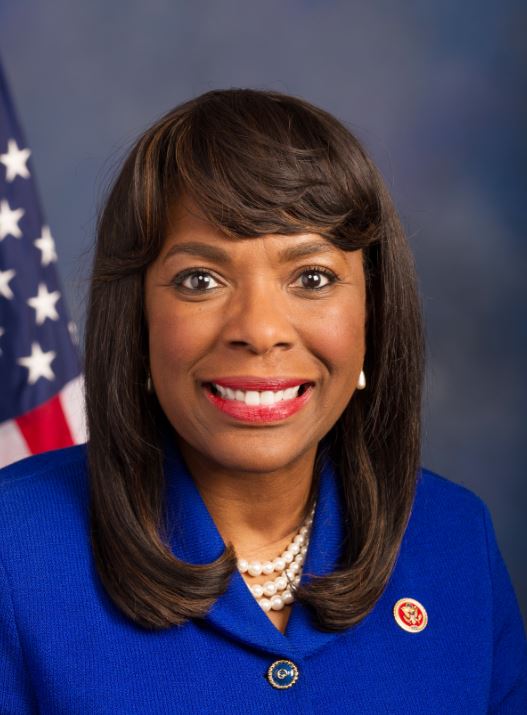

Terri Sewell is a Democrat elected to Congress in 2010, according to her official biography. Her AI-related record is short: one cosponsored bill, two recorded House votes and a 2024 oversight letter she led with Shontel Brown.
Of the three bills discussed below, only one has become law: the TAKE IT DOWN Act.
- Party
- Democratic
- State
- Alabama
- Office
- U.S. Representative, Alabama's 7th congressional district (current office in the 2026 Congressional Directory)
- Age
- 61 as of 2026-11-05 · Source
- Political Leaning
- Not established beyond party affiliation.
- Election Status
- Reelection reported: an Associated Press call in Alabama's 7th district on November 3, 2026, at 9:24 p.m. CST, according to the Alabama Political Reporter. No certification record appears in the cited sources.
Terri Sewell's Position on AI
Terri Sewell supports a conditional pause on construction and upgrades of covered AI data centers. She is an original cosponsor of House bill (H.R.) 9442, the Artificial Intelligence Data Center Moratorium Act, which would halt that work upon enactment.
The pause ends only after separate laws cover a set of listed protections, and the bill sets no fixed one-year expiry.
Sewell rejects the anti-AI label directly. In a July 21, 2026, press release announcing the bill, she said: "I am not anti-AI, and I am certainly not anti-innovation."
Her recorded House votes include two Yea votes on AI-related bills. The Clerk of the House recorded her Yea on the AI for Main Street Act on January 20, 2026 and on the TAKE IT DOWN Act on April 28, 2025. Both were House motions to suspend the rules and pass the bill.
Background at a Glance
Terri Sewell is a Democrat who serves as U.S. Representative for Alabama's 7th congressional district, according to the 2026 Congressional Directory.
| Item | Detail | Source |
|---|---|---|
| Birth | Huntsville, Alabama, January 1, 1965 | Congressional Directory |
| Age | 61 on November 4, 2026 | Calculated from the directory's birth date |
| Party | Democratic | Congressional Directory |
| Current office | U.S. Representative, Alabama's 7th congressional district | Congressional Directory |
| Office sought in 2026 | Reelection to the same district | Alabama Political Reporter |
| Ideological leaning | No sourced label; not inferred from party | Not assigned |
Background and Political Leaning
It describes her as the first Black valedictorian of Selma High School, and it says her mother, Nancy Gardner Sewell, served on the Selma City Council. This summary draws no link between those personal details and her later AI positions.
The 2026 Congressional Directory lists a Bachelor of Arts (B.A.) cum laude from Princeton University in 1986 and a Master of Arts (M.A.) with first class honors from Oxford University in 1988. It also lists a Juris Doctor (J.D.) from Harvard Law School in 1992.
Her official biography describes her as a securities and public-finance attorney before her election to Congress in 2010.
No sourced ideological label is available for Sewell, so none is assigned here. Party membership alone would not establish a finer ideology.
Statements and Actions on AI
Sewell's personal statement on AI in the sources cited here is her July 21, 2026, press release on the data center bill. The release describes potential AI benefits in health care, education and the economy. It says she wants U.S. leadership and Alabama participation in AI innovation, while requiring community protections, and its headline frames the bill as a pause until federal guardrails are established.
On March 13, 2024, Sewell and Shontel Brown led a bipartisan letter to the Department of Justice (DOJ), the Department of Homeland Security (DHS) and the Election Assistance Commission (EAC). The letter asked those agencies for action and information on AI-enabled voter intimidation and misinformation, particularly targeting minority communities. The office's release quotes Sewell: "We cannot allow bad actors to weaponize powerful AI tools to mislead voters, suppress turnout, and sow chaos."
The letter is joint, so the quoted line reflects Sewell's words only as published in her office's release. The release reports her documented position and does not independently establish the harms it alleges.
Policies Supported and Opposed
Sewell's documented AI record covers one cosponsored data center bill, two Yea votes and one 2024 letter. The cited records show no individually documented opposition to a specific AI policy.
Of the bills in the table, only the TAKE IT DOWN Act has become law, as Public Law 119-12. The AI for Main Street Act passed the House and has no law entry, and H.R. 9442 is an introduced bill with no enactment recorded.
The TAKE IT DOWN Act, Senate bill (S.) 146, addresses knowing publication of nonconsensual intimate depictions, including specified digital forgeries created with AI or other software, subject to the law's conditions and exceptions. Covered platforms must set up a notice and removal process within one year of enactment. They must remove covered depictions within 48 hours of a valid request and make reasonable efforts to remove known identical copies, according to the enrolled text on GovInfo. It is a restriction on one harmful use, and it does not ban all AI or all synthetic media.
The House-passed text of the AI for Main Street Act would require small business development centers to help businesses evaluate and use AI. Its information, guidance, training and outreach would cover best practices, business operations, data and intellectual property, cybersecurity, regulatory compliance and trust. Section 3 authorizes no additional funding.
A yea vote supports that business-assistance bill as a whole, and its provisions describe business help and training.
The introduced text of H.R. 9442 would do four things, listed below. Sewell's support is shown by her cosponsorship record, since the introduced text is a proposal and not law.
- Covered facilities: AI data centers used for AI models at scale, plus an alternative branch for facilities over 20 megawatts (MW) with high-density rack power of at least 20 kilowatts (kW) or liquid or immersion cooling. The bill does not automatically cover every server facility.
- Pause conditions: the pause ends only after laws establish product review, worker and benefit-sharing protections, utility and environmental protections, community approval, no subsidies and union labor standards, and those laws must expressly terminate the pause.
- Reporting: the Energy Department would publish quarterly reports on financing, water, power, emissions, wastewater, cooling chemicals, noise, jobs, agreements and subsidies.
- Enforcement and exports: verification powers would include inspections and subpoenas, and the bill would restrict computing-infrastructure exports, reexports and in-country transfers for covered AI uses to entities in countries without comparable safeguards.
| Date | Item | Sewell's documented role | Status in the cited records |
|---|---|---|---|
| March 13, 2024 | Letter to DOJ, DHS and EAC on AI-enabled voter intimidation and misinformation | Led with Shontel Brown | Letter only; not a bill or vote |
| April 28, 2025 | TAKE IT DOWN Act, S. 146 | Recorded Yea on House motion to suspend the rules and pass | Became Public Law 119-12 on May 19, 2025 |
| January 20, 2026 | AI for Main Street Act, H.R. 5764 | Recorded Yea on House motion to suspend the rules and pass as amended | Passed House 395 to 14; received in the Senate and referred January 26, 2026; no law entry |
| June 24, 2026 | Artificial Intelligence Data Center Moratorium Act, H.R. 9442 | Original cosponsor | Introduced; referred to Energy and Commerce and, in addition, Foreign Affairs; no enactment recorded |
Current Office and the 2026 Election
Sewell was reelected in Alabama's 7th congressional district, according to an Associated Press (AP) call reported by the Alabama Political Reporter.
The local report places the call at 9:24 p.m. Central Standard Time (CST) on November 3, 2026, and it does not give final vote shares.
No certification record appears in the cited sources. That absence is an evidence limit, not a finding that certification has not occurred.
Her current office is U.S. Representative for Alabama's 7th district, as listed in the February 20, 2026, directory. That directory predates the November vote and cannot confirm its results.
Scope and Open Questions
H.R. 9442 is an introduced bill with no enactment recorded, so the data center pause remains a proposal. Its latest recorded action is the June 24, 2026, referral, and the cited records do not show whether committees will act on it.
The cited records contain no House roll call on H.R. 9442. The Senate passed the TAKE IT DOWN Act by unanimous consent on February 13, 2025, so no individual Senate roll call is recorded for it.
The record is not exhaustive. It does not cover every AI statement, vote or cosponsorship by Sewell, and a Yea vote on an AI-related bill does not show her position on every AI use.
Where the cited records show no objection, that gap means the position is unknown. It does not establish opposition, and the cited records show no motive for any vote.
To check whether H.R. 9442 has moved, start with the GovInfo bill status record, which lists its latest action. Then read the bill text on Congress.gov to see what the introduced version would do.
Frequently Asked Questions
Has the Artificial Intelligence Data Center Moratorium Act become law?
No. H.R. 9442 was referred to the Committee on Energy and Commerce and, in addition, to the Committee on Foreign Affairs. The GovInfo bill status record records no enactment.
Did Terri Sewell vote for the TAKE IT DOWN Act?
Yes. The Clerk of the House roll call on April 28, 2025 records her Yea on the motion to suspend the rules and pass the bill. The House vote was 409 to 2, and the measure became Public Law 119-12 on May 19, 2025.
Does Terri Sewell oppose artificial intelligence?
The cited records do not show that. Sewell has said she is not anti-AI, and her data center pause is conditional. The cited records contain no individually documented objection to a specific AI policy.